
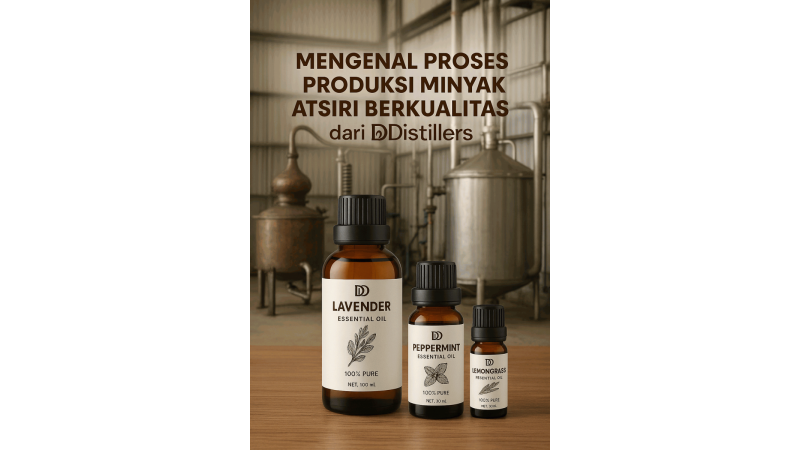

Essential oils are valuable natural products that play a significant role across various industries, ranging from perfumes and cosmetics to food and pharmaceuticals. The quality of essential oils greatly influences their market value and effectiveness in application. Therefore, a precise and high-quality production process is crucial to deliver superior products. One notable company renowned for producing top-quality essential oils is DDistillers.
This article explores the detailed production process of quality essential oils by DDistillers, covering raw material selection, extraction methods, and quality control measures.
What Are Essential Oils and Their Benefits?
Essential oils are concentrated liquids extracted from plants through distillation or other extraction methods, containing aromatic compounds and active ingredients that provide characteristic scents and therapeutic properties. These oils are widely used in aromatherapy, skincare products, air fresheners, as well as raw materials in pharmaceutical and food industries.
The benefits of essential oils vary depending on the source plant. For example, lemongrass oil is known for its antifungal and antibacterial properties, lavender oil offers calming effects, and eucalyptus oil is commonly used to relieve respiratory issues.
Profile of DDistillers as an Essential Oil Producer
DDistillers is a company specialized in producing essential oils that meet international quality standards. With years of experience, DDistillers combines modern technology with traditional methods to preserve the purity and authenticity of their oils. Their commitment to quality and sustainability forms the foundation of every stage in their production process.
High-Quality Raw Materials: The Starting Point
Producing high-quality essential oils begins with selecting premium raw materials. DDistillers enforces strict criteria to ensure only fresh, pesticide-free plants are used. Commonly sourced plants include lemongrass, patchouli, cloves, eucalyptus, and jasmine, cultivated in regions with ideal climatic and soil conditions to yield superior oil quality.
Moreover, DDistillers collaborates directly with local farmers to secure a sustainable and consistent supply of raw materials while supporting the local economy.
Extraction Methods at DDistillers
DDistillers employs several proven and environmentally friendly extraction methods to obtain essential oils. The primary techniques are steam distillation and solvent extraction.
Steam Distillation
Steam distillation is the traditional and most widely used method for extracting essential oils. Fresh or dried plant materials are placed in a distillation apparatus, and steam is passed through to vaporize the oil components. The vapor is then condensed back into liquid, where the oil separates from the water.
This method produces relatively pure oils without degradation from excessive heat. DDistillers uses advanced distillation equipment with precise control over temperature and pressure to maximize extraction yields and maintain oil quality.
Solvent Extraction
For plants whose oils are not easily extracted by steam, DDistillers utilizes solvent extraction with safe and volatile solvents. After extraction, the solvent is removed, leaving behind pure essential oil. This method allows for the capture of a fuller range of aromatic compounds and richer oil profiles.
Quality Control and Standards
After extraction, the essential oils do not immediately go to packaging and distribution. DDistillers implements rigorous quality assurance protocols to ensure each product meets established standards.
Gas Chromatography Analysis (GC)
GC is used to analyze the chemical composition of essential oils in detail. This technique enables DDistillers to verify that every batch contains consistent and appropriate compound profiles, guaranteeing product uniformity.
Organoleptic Testing
In addition to laboratory tests, oils undergo organoleptic evaluation by aroma experts who assess scent characteristics to confirm they match the natural plant profile.
Safety and Purity Testing
Essential oils are also tested to ensure they are free from contaminants such as heavy metals, harmful microbes, and pesticide residues. This guarantees the oils are safe for use in topical, aromatic, and food applications.
Innovation and Sustainability in Production
Beyond quality, DDistillers is committed to sustainable production practices. They incorporate renewable energy sources in their distillation processes, manage waste responsibly, and conserve plant resources to maintain ecological balance.
The company also invests in research and development to explore more efficient, eco-friendly extraction methods and expand their essential oil portfolio.
Applications of DDistillers’ Essential Oils
The high-quality essential oils from DDistillers find extensive use in numerous industries. In cosmetics, they serve as key ingredients for perfumes and natural skin care products. In healthcare, they are employed in aromatherapy to promote relaxation and mental well-being. Furthermore, essential oils act as natural preservatives and flavorings in food production.
Conclusion
Producing premium essential oils is a meticulous process that requires careful raw material selection, precise extraction techniques, and stringent quality control. DDistillers exemplifies how integrating these elements with a commitment to sustainability results in pure, effective, and safe essential oils suitable for diverse applications. For those seeking essential oils that meet international standards, DDistillers stands out as a reliable choice.


Leave Your Comment