Halal
Certificate: 33110034666001125
Export
Documentation Available
- Certificate of Analysis (COA)
- Material Safety Data Sheet
(MSDS)
- Phytosanitary Certificate
- CITES permit (required for
international trade)
Rose
Absolute Oil (Rosa spp.) is a highly concentrated aromatic material;
therefore, in all applications it should be used at low levels and properly
diluted. Perfumery and aromatherapy literature indicates that typical usage
levels of rose absolute generally range from 0.05–5%, depending on the
formulation purpose (cosmetics, perfumery, or aromatherapy).
Personal
Formulation – Aromatherapy Roll-On (Emotional Relaxation)
Formulation
Objective
To provide a soft, warm floral aroma for personal use, based on a carrier oil
system that is easy to apply and stable.
Ingredient
Composition
- Rose Absolute Oil: 0.5%
- Lavender Essential Oil (Lavandula
angustifolia): 1.0%
- Bergamot Essential Oil (FCF): 0.5%
- Jojoba Oil (carrier oil): q.s. to
100%
Total
aromatic material concentration: 2.0% (considered safe for adult topical use
according to aromatherapy literature).
Preparation
Method
- Accurately weigh Rose Absolute Oil
(use of an analytical balance is recommended).
- Blend with the other essential oils
until homogeneous.
- Gradually add jojoba oil while gently
stirring.
- Transfer into a dark glass roll-on
bottle.
- Allow to mature for 24–48 hours for
aroma development.
Directions
for Use
- Apply to the wrists or behind the
ears.
- Use 1–2 times daily as needed.
Safety
& Testing
- Perform a patch test 24 hours prior
to use.
- Not recommended for pregnant women
without professional consultation.
- Store in a cool and dark place.
Personal–Professional
Formulation – Oil-Based Facial Serum
Formulation
Objective
To provide a calming natural aroma while supporting sensory comfort in
non-aqueous (anhydrous) skincare products.
Ingredient
Composition
- Rose Absolute Oil: 0.2%
- Frankincense Essential Oil (Boswellia
carterii): 0.3%
- Vitamin E (Tocopherol): 0.5%
- Rosehip Seed Oil: q.s. to 100%
Rose
absolute concentration ≤0.2%, in accordance with sensitive cosmetic practices
(Baser & Buchbauer).
Preparation
Method
- Combine the essential oils and
absolute in a sterile glass container.
- Add vitamin E as an antioxidant.
- Add rosehip seed oil and mix until
homogeneous.
- Fill into an amber glass bottle with
dropper.
Directions
for Use
- Apply 2–3 drops to clean facial skin
in the evening.
- Avoid the eye area.
Safety
& Testing
- Conduct a simple stability test
(monitor odor, color, and clarity over 30 days).
- Perform a patch test prior to use.
- Do not apply to open or damaged skin.
7.3.
Industrial Formulation – Alcohol-Based Perfume (Fine Fragrance)
Formulation
Objective
To utilize Rose Absolute as a middle-to-base note in alcohol-based perfumes, in
line with perfumery industry practices.
Example
Perfume Concentrate Formula
- Rose Absolute Oil: 5–10%
- Jasmine Absolute: 2%
- Benzoin Resinoid: 3%
- Natural Linalool Isolate: 1–2%
- Ethanol 95%: q.s. to 100%
In
industry, rose absolute is frequently used as a key floral anchor due to its
stability and aromatic complexity (Sell, 2019).
Preparation
Method
- Dissolve all aromatic materials in
ethanol.
- Mix until homogeneous.
- Allow aging/maceration for 2–6 weeks
at a stable temperature.
- Filter if necessary.
- Conduct sensory evaluation.
Directions
for Use
- Intended for external spray perfume
application.
- Final concentration adjusted
according to fragrance type (EDT, EDP, Extrait).
Industrial
Safety & Testing
- Temperature stability testing (4°C,
25°C, 40°C).
- Clarity and precipitation testing.
- IFRA compliance evaluation (for
commercial products).
- Skin irritation testing (in vitro or
voluntary patch testing).
7.4.
General Safety Notes in Formulation
- Rose Absolute Oil should not be used
directly without dilution.
- Low concentrations are recommended
due to the presence of active aromatic compounds.
- Final products must comply with
applicable local regulations (cosmetics/perfumery).
- Rose Absolute Oil is not a medicine
and is not intended to diagnose, treat, cure, or prevent any disease.
- This information is provided for
educational and aromatherapy purposes only and does not constitute medical
advice.
- Therapeutic use has not been
clinically tested in humans.
A.
Kegunaan Rose Absolute Oil dalam Bidang Industri
1.
Industri Parfum & Fragrance (Fine Perfumery)
Rose
Absolute Oil merupakan salah satu bahan baku inti dalam industri parfum
kelas menengah hingga premium.
Kegunaan
utamanya:
- Sebagai
middle note hingga base note floral
- Memberikan
kedalaman, kehangatan, dan naturality pada komposisi parfum
- Bertindak
sebagai aroma anchor yang mengikat komponen floral lain
Secara
ilmiah, rose absolute dipilih dibanding rose otto karena:
- profil
aromanya lebih kompleks
- kandungan
ester aromatik dan phenyl derivatives lebih tinggi
- stabil
dalam basis alkohol
2.
Industri Kosmetik & Personal Care
Rose
Absolute Oil digunakan dalam:
- produk
perawatan wajah (serum, facial oil)
- krim
dan balm aromatik
- produk
spa dan wellness premium
Perannya
bersifat:
- sensorik
(aroma & pengalaman pengguna)
- fragrance
ingredient alami
- pendukung
konsep luxury natural cosmetic
Penggunaan
dibatasi pada konsentrasi rendah karena potensi iritasi bila berlebihan, sesuai
praktik kosmetik ilmiah.
3.
Industri Aromaterapi Profesional
Dalam
aromaterapi profesional, rose absolute digunakan:
- sebagai
bahan aroma untuk sesi relaksasi
- dalam
formulasi psikoaromaterapi
- sebagai
aroma penunjang kesejahteraan emosional
Literatur
aromaterapi modern membedakan antara aroma effect (sensory) dan klaim
medis, sehingga rose absolute digunakan sebagai supportive wellness tool,
bukan obat.
4.
Industri Farmasi Tradisional & Herbal Aromatik
Dalam
konteks farmasi non-klinis:
- digunakan
sebagai flavoring dan aroma masking agent
- meningkatkan
kepatuhan pengguna terhadap produk herbal
Penggunaan
ini bersifat teknologis dan sensorik, bukan terapeutik langsung.
B.
Kegunaan Rose Absolute Oil dalam Non-Industri (Personal & Edukasi)
- Pengharum
ruang alami (diffusion terbatas)
- Minyak
aromatik personal
- Media
edukasi botani, kimia aroma, dan aromaterapi
- Produk
wellness rumahan (roll-on, balm)
1.
Effects on Emotional Regulation and Mood
Research
indicates that rose aroma:
- influences the limbic system
(amygdala and hippocampus)
- is associated with reduced stress
responses
- enhances feelings of comfort and
positive emotions
Neurophysiological
and psychological studies suggest that inhalation of rose aroma may:
- reduce sympathetic nervous system
activity
- increase subjective relaxation
2.
Potential Anxiolytic (Mild Anti-Anxiety) Effects
Several
experimental studies report that rose aromatic compounds:
- are associated with reduced mild
anxiety
- indirectly influence brain waves and
heart rate
These
effects are:
- psychological and sensorial
- dependent on individual perception
- not directly pharmacological
3.
Support for Relaxation and Sleep Quality
Rose
aroma has been reported to:
- help create a calming atmosphere
- support relaxation prior to sleep
- be used as a supportive aroma in
sleep hygiene practices
Inhalation
studies show correlations between certain floral aromas and improved subjective
sleep comfort.
4.
Potential Mild Anti-Inflammatory Activity (Experimental)
Some
in vitro and in vivo (non-clinical) studies indicate that rose extracts and
oils:
- exhibit mild anti-inflammatory
activity
- are associated with phenyl
derivatives and aromatic alcohol content
5.
Sensory Benefits in Skin Care
In
cosmetic applications:
- rose absolute aroma contributes to
perceived soothing effects
- enhances the overall product usage
experience
- supports psychological relaxation
during skin care routines
These
benefits are sensorial and emotional in nature, not dermatological cures.
- Scent
and Chemistry: The Molecular World of Odors – Günther Ohloff, Wilhelm
Pickenhagen, Philip Kraft
- The
Scent of Roses and Beyond: Molecular Structures, Analysis and Practical
Applications of Odorants
- Advances
in Rose Aroma Research and Applications
- Extraction
and Chemical Profiling of Rose-Derived Natural Products
- Chemical
Composition and Bioactivity of Rose Extracts
- Recent
Advances in the Chemistry and Bioactivity of Rose-Derived Compounds
- Biological
Activities of Rose Essential Oils and Absolutes
- Genomic
and Metabolic Regulation of Rose Floral Scent
- Horticultural
and Phytochemical Aspects of Rosa Species
- Chemical
Composition of Rosa hybrida Essential Oil as a Function of Location and
Storage in Saudi Arabia
- Environmental
and Agricultural Perspectives on Rose Cultivation
- Phytochemical
and Biological Studies of Rosa Species
- Aromatic
Compounds and Biological Properties of Roses
- Electron
Microscopical Studies of Rose Petal Cells during Flower Maturation
- Molecular
Mechanisms of Floral Scent Biosynthesis in Roses
- Rose
Scent Genomics and Discovery of Floral Fragrance-Related Genes
- Encyclopedia
of Rose Science
- Exploring
Complex Ornamental Genomes: The Rose as a Model Plant
- Handbook
of Essential Oils: Science, Technology, and Applications
- Historical
and Scientific Perspectives on Rose Oils
- Perfume
and Flavor Materials of Natural Origin – Steffen Arctander
- Rosa:
The Story of the Rose
- The
Story of the Rose – World of Flowering Plants
- A
Brief History of the Rose
- Relaxing
Effects of Rose Oil on Humans
- Physiological
and Psychological Effects of Floral Aromas
- Volatile
Oils: Chemistry, Pharmacology, and Applications
- Plant
Volatile Compounds: Biosynthesis and Function
- Biochemistry
of Plant Volatiles
- Chemical Composition and Biological Activities of the Essential Oils from Different Parts of Rosa bracteata
- Recent
Advances in Rose Floral Scent Biosynthesis and Regulation
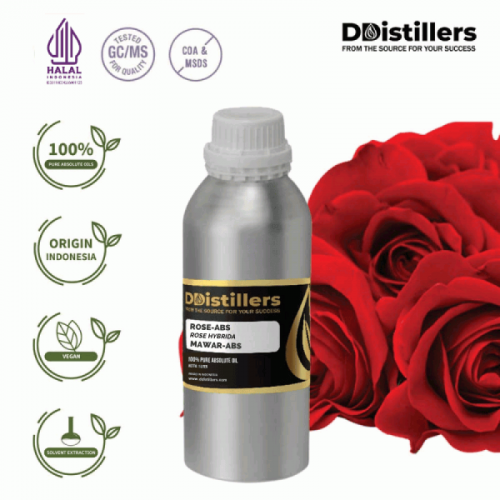
ROSE
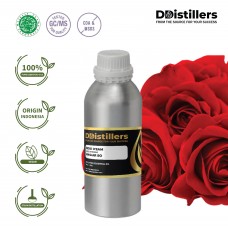
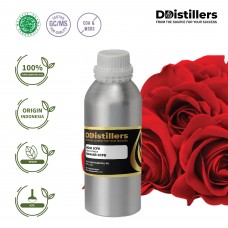
ABSOLUTE OIL / MINYAK ABSOLUT BUNGA MAWAR By DDISTILLERS
Brand:
DDistillers
INCI name: Rosa Hybrid Flower Extract
Product Category: Single Absolute Oil, purity: 100%
HS Code: 33012990
CAS#: –
FEMA#: –
Extraction
method: Solvent extraction.
PRODUCT
DESCRIPTION
Rose
Absolute Oil is a natural aromatic material obtained from rose flowers (Rosa
× hybrida) through non-polar solvent extraction (n-hexane), followed by
purification with alcohol to produce the absolute fraction. In scientific
literature, solvent extraction is recognized as the most effective technique
for preserving heavy and heat-sensitive aromatic compounds, such as aromatic
esters and phenyl ethers, which are largely degraded or lost during steam
distillation. Consequently, rose absolute is sensorially regarded as having a
more complex, richer aroma that more closely resembles the scent of fresh rose
flowers compared to steam-distilled rose oil (rose otto).
Physically,
rose absolute oil appears as a mobile liquid with a transparent yellow
coloration. Gas chromatography (GC) analysis of this product indicates the
presence of benzyl acetate and phenyl ether within the reported quality
specification ranges. Several studies identify benzyl acetate as a major
contributor to the sweet, floral, and fresh aromatic character of roses,
playing a significant role in the “petal-like” and natural impression.
Meanwhile, phenyl ether compounds and their derivatives contribute to aromatic
depth, powdery nuances, and the stability of the fragrance profile from the
middle to base note phases.
In
terms of solubility, this Rose Absolute Oil is soluble in alcohol and oils but
insoluble in water, consistent with the lipophilic nature of its aromatic
constituents. This characteristic scientifically underpins its application in
ethanol-based perfumes, aromatherapy oils, and non-aqueous cosmetic
formulations.
Organoleptically,
Rose Absolute Oil exhibits a complex and progressive aromatic development. The
initial phase is characterized by a soft, sweet floral impression, followed by
a rich, warm, and slightly honey-like rose character in the middle phase. In the
final phase, light resinous, balsamic, and powdery nuances emerge and persist,
reflecting the presence of heavy aromatic compounds with low volatility. This
sensory profile is consistent with organoleptic descriptions of rose absolute
reported in various perfumery studies and sensory analyses, which emphasize
high tenacity and aromatic depth as defining characteristics of high-quality
rose absolute.
BOTANICAL
AND MORPHOLOGICAL CHARACTERISTICS
Botanical
Classification
- Kingdom:
Plantae
- Division:
Tracheophyta
- Class:
Magnoliopsida
- Order:
Rosales
- Family:
Rosaceae
- Genus:
Rosa L.
- Group:
Rosa hybrida (horticultural group)
Rosa
hybrida is not a single botanical species but a complex
hybrid group resulting from crosses among various Rosa species (notably R.
chinensis, R. gallica, R. damascena, and R. moschata).
In scientific and horticultural literature, the term Rosa hybrida is
used to describe modern cultivated roses characterized by large flowers,
distinctive fragrance, and extensive color diversity.
Plant
Habit and Structure
Rosa
hybrida is a woody shrub with a height ranging from
approximately 0.5 to 2.0 meters, depending on the cultivar and cultivation
system.
Key
habit characteristics include:
- Woody, branched stems typically
bearing prickles
- A fibrous–shallow taproot system
adapted to loose, well-aerated soils
- Active vegetative growth under
temperate to subtropical climates, with many aromatic cultivars cultivated
in tropical highland regions
Physiologically,
rose plants exhibit high secondary metabolic activity during the flowering
stage, particularly in the biosynthesis of volatile aromatic compounds.
Leaf
Morphology
The
leaves of Rosa hybrida are pinnately compound and typically consist of:
- 5–7 leaflets
- Elliptic to oval leaflet shape
- Serrated leaf margins
- Dark green, glossy upper surfaces
with paler undersides
Leaves
play a crucial role in photosynthesis and in supplying biochemical precursors
(carbohydrates and phenylalanine) necessary for the formation of aromatic
compounds in flowers, as reported in rose metabolomic studies.
Flower
Morphology
The
flower is the most important organ in the context of Rose Absolute Oil
production.
Key
characteristics of Rosa hybrida flowers include:
- Hermaphroditic flowers
- Flower diameter ranging from 5–12 cm
- Floral structures consisting of:
- Sepals:
5, green
- Petals:
multi-layered, with high petal numbers resulting from hybrid selection
- Stamens:
numerous
- Pistil:
centrally located
Research
indicates that glands responsible for volatile aromatic compound production are
primarily located in the petal epidermis, particularly within papillate
epidermal cells. These cells actively synthesize and release aromatic compounds
during the full-bloom stage.
Aroma-Producing
Tissues
Aroma
production in Rosa hybrida occurs through:
- Epidermal cells of flower petals
- Enzymatic activity of the following
pathways:
- Phenylpropanoid
- Shikimate
- Secondary terpenoid pathways
Compounds
such as benzyl alcohol, benzyl acetate, phenyl ethyl derivatives, and phenyl
ethers are produced and volatilized for ecological functions, primarily to
attract pollinators. Molecular studies demonstrate that the expression of
aroma-related genes increases significantly when flowers reach peak bloom.
Morphological
Variability and Its Influence on Aroma
As
a hybrid group, Rosa hybrida exhibits high morphological variability,
including:
- Petal number and thickness
- Epidermal tissue density
- Aroma intensity and quality
Comparative
studies indicate that cultivars with thicker and more densely layered petals
tend to contain higher levels of aromatic compounds, making them more suitable
for the production of aromatic extracts such as rose absolute.
HISTORY
AND USE
Early
History of Roses as Aromatic Plants
The
use of roses as aromatic plants has been documented for thousands of years.
Archaeological evidence and historical texts indicate that roses were
cultivated and utilized in ancient Persia, Egypt, Greece, and Rome. Roses were
used as fragrance materials, cosmetics, ritual substances, and embalming
agents. In ancient Egypt, roses were associated with perfumery and beauty
practices, while in Persian tradition they symbolized aesthetics and
spirituality.
During
this period, roses were not yet processed into absolutes. Aromatic utilization
primarily involved:
- floral macerations,
- aromatic ointments,
- oil infusions,
- and hydrosols obtained from simple
distillation.
Development
of Rose Oil Extraction Technology
Rose
distillation technology advanced significantly during the Islamic Golden Age.
Avicenna (Ibn Sina), in the 10th–11th centuries, is associated with the
refinement of steam distillation processes to obtain rose water and rose oil
(rose otto).
Rose
otto became a high-value product in:
- Turkey
- Bulgaria (Kazanlak Valley)
- Iran
Large-scale
production expanded during the 18th and 19th centuries. However, steam
distillation has inherent limitations, particularly the loss of heat-sensitive
aromatic compounds.
Emergence
of Rose Absolute Oil
Rose
Absolute Oil emerged following the development of organic solvent extraction in
the 19th century. This technology originated in France, beginning with the use
of fat-based solvents (enfleurage) and later transitioning to volatile solvents
such as n-hexane.
The
basic production stages include:
- Extraction of rose flowers with
hexane to obtain concrete
- Ethanol extraction of the concrete to
separate waxes
- Recovery of the concentrated aromatic
fraction as rose absolute
This
innovation enabled:
- higher yields
- more complex aroma profiles
- better preservation of aromatic
esters and phenyl ethers compared to rose otto
As
a result, rose absolute became a key material in European fine perfumery from
the 19th century to the present.
History
of Rose Absolute Use in Perfumery
Since
the 19th century, Rose Absolute has been used as:
- a middle-to-base note component in
luxury perfumes
- a binding agent for other floral
aromas (such as jasmine and ylang-ylang)
- a builder of classic accords such as
floral, chypre, and oriental
Rose
Absolute became a cornerstone material in iconic perfumes due to:
- high tenacity
- complex aroma
(floral–honeyed–resinous)
- stability in alcohol-based
formulations
Industrially,
rose absolute is primarily sourced from:
- Bulgaria
- Turkey
- Morocco
- France
- India
Use
in Health Traditions and Psychoaromatherapy
Throughout
history, aromatic rose materials have been used for:
- relaxation
- spiritual rituals
- space fragrancing
- social and symbolic status
In
modern contexts, scientific studies indicate that rose aroma:
- influences the limbic system
- is associated with emotional
regulation
- contributes to positive psychological
experiences
Rose
Absolute has subsequently been incorporated into:
- modern clinical aromatherapy
- psychological research on scent
- non-medical wellness applications
However, formal therapeutic use still requires rigorous clinical evaluation; therefore, it is not claimed as a medicinal agent in the context of public education.



| Specification | |
|---|---|
| Source of Material | Raw material source: Fresh rose petals obtained from Rosa × hybrida. Origin: Indonesian |
| Cultivation | Hybrid rose plants are intensively cultivated as ornamental and aromatic crops, with flower harvesting carried out at the optimal blooming stage to preserve the content of volatile aromatic compounds. |
| Main Content | Benzyl Acetate, Phenyl ether, β-Citronellol, Geraniol, Nerol, Phenethyl Alcohol, Farnesol, Linalool |
| Organoleptik |
|
| Solubility | Soluble in alcohol and fixed oils, insoluble in water. |
| Level of note | Middle note to Base note |
| Downstream product application | Aromatherapy, Natural Perfumery, Toiletries, Natural Cosmetics, Herbal Pharmacy, Body/Skin Care, Personal Care, Home Care, and other derivative products. |
| Shelf Life | 5 years |
| Storage instructions |
|
| Allergies and general precautions |
|
Related Products
-228x228.jpg)


1LSS-228x228.png)