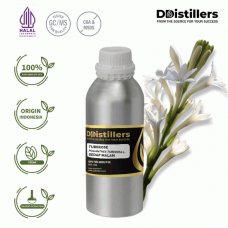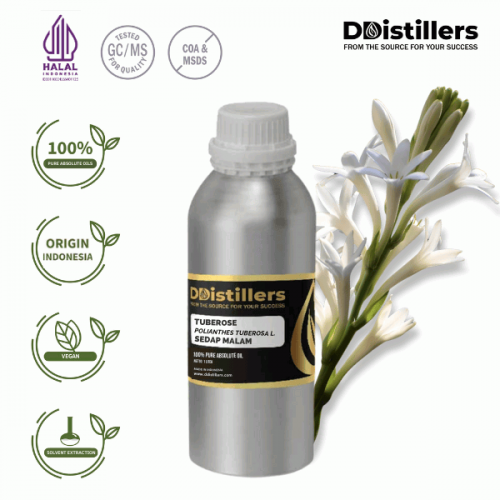
Tuberose
Absolute Oil is an aromatic material with a high content of ester compounds and
aromatic nitrogen compounds (e.g., methyl anthranilate, benzyl acetate, methyl
benzoate), which are potent, lipophilic, and sensitive to oxidation. Therefore,
in formulations it is always used at low concentrations, diluted in carrier
oils or alcohol, and applied in accordance with dermal safety and stability
principles as recommended by scientific aromatherapy literature and
international cosmetic standards.
A.
NON-INDUSTRIAL FORMULATIONS (PERSONAL USE)
1.
Roll-On Aromatherapy (Relaxation & Emotional Support)
Intended
use:
Psychological relaxation, mood enhancement, personal aromatherapy
Composition:
- Tuberose Absolute Oil: 0.5%
- Lavender Essential Oil (Lavandula
angustifolia): 1%
- Bergamot FCF Essential Oil: 1%
- Carrier Oil (Jojoba / Fractionated
Coconut Oil): 97.5%
Preparation
method:
- Accurately weigh the essential oils
and absolute oil using a precision scale.
- Blend them into the carrier oil.
- Stir gently until homogeneous.
- Store in a dark glass roll-on bottle.
Directions
for use:
- Apply to the wrists or behind the
ears.
- Use up to a maximum of twice daily.
Scientific
notes:
- This concentration follows dermal
safety recommendations for aromatic materials with high aromatic ester
content.
- Lavender and bergamot function as
aroma modulators while also supporting nervous system balance.
2.
Sensorial Body Oil (After-Bath Oil)
Intended
use:
Skin care with sensorial and aromatic effects
Composition:
- Tuberose Absolute Oil: 0.3%
- Sweet Almond Oil: 70%
- Jojoba Oil: 29%
- Vitamin E (Tocopherol): 0.7%
Preparation
method:
- Combine all ingredients in a sterile
glass container.
- Mix until homogeneous.
- Bottle the product and label it with
the manufacturing date.
Directions
for use:
- Apply to damp skin after bathing.
Formulation
rationale:
- Vitamin E acts as an antioxidant to
prevent oxidation of aromatic compounds.
- The concentration of absolute oil is
kept low to minimize the risk of irritation.
B.
INDUSTRIAL FORMULATIONS (COSMETICS & PERFUMERY)
3.
Natural Fine Fragrance (Alcohol-Based Perfume)
Category:
Natural Perfumery
Composition
(example of a 10% perfume concentrate):
- Tuberose Absolute Oil: 1.5%
- Jasmine Absolute / Sambac Absolute:
1%
- Ylang-Ylang Extra: 0.5%
- Sandalwood Oil: 0.5%
- Ethanol 95% (food/pharma grade):
96.5%
Manufacturing
process:
- Dissolve all aromatic materials into
ethanol.
- Stir gently.
- Allow maceration for 2–4 weeks in a
cool, dark place.
- Filter if necessary.
Industrial
applications:
- Natural perfumes
- Luxury personal fragrances
- Artisan perfumery
4.
Aromatherapy Cosmetic Cream (Leave-On Product)
Category:
Natural cosmetics
Maximum
level of Tuberose Absolute Oil: ≤ 0.2%
Important
notes:
- Stability testing, preservative
efficacy testing, and patch testing are mandatory prior to
commercialization.
- Compliance with ISO 16128 standards
(natural cosmetic ingredients) is recommended.
C.
SAFETY, TESTING & QUALITY CONTROL
1.
Formulation Safety Measures
- Do not use without dilution.
- Avoid use in:
- Pregnant women during the first
trimester
- Children under 6 years of age
- Sensitive skin without prior patch
testing
2.
Recommended Testing
For
industrial products:
- Patch test (Human Repeat Insult Patch
Test – HRIPT)
- Stability testing (temperature, light
exposure, oxidation)
- GC–MS profiling (batch consistency)
- Microbial testing (for water-based
products)
For
personal use:
- 24-hour patch test on the inner arm
D.
SCIENTIFIC BASIS & FORMULATION REFERENCES
The
above formulations are based on:
- Clinical aromatherapy principles
- Natural cosmetic formulation
literature
- Traditional and modern perfumery
practices
- Tuberose
(Polianthes tuberosa L.): Botany, Cultivation and Uses (HORT 281 Lecture
Notes)
- The
Encyclopedia of Psychoactive Plants: Ethnopharmacology and Its Applications –
Christian Rätsch
- The
Genus Polianthes: Botanical and Historical Review
- Polianthes
tuberosa – Botanical Overview
- A
Review on Ethnomedicinal Properties of Polianthes tuberosa
- Polianthes
Tuberose Breeding in Indonesia
- Handbook
of Essential Oils: Science, Technology, and Applications
- Tuberose
in Perfumery: Properties, Distillation, and History
- Biological
Activities of Essential Oils and Their Components
- Olfactory
Effects of Floral Aromatic Compounds on Mood and Emotion
- Neuropsychological
and Physiological Effects of Odor-Evoked Memory
- Chemical
Composition and Bioactivity of Floral Extracts
- Floriculture:
Principles and Species
- Chemical
Composition of Polianthes tuberosa Flower Extracts at Different
Extraction Methods
- Volatile
Constituents Emitted by Polianthes tuberosa Flowers
- Extraction
Methods for Tuberose Oil and Their Chemical Components
- Volatile
Releasing Patterns of Tuberose Flowers at Different Maturity Stages and Diurnal
Times
- Mexican
Geophytes I: The Genus Polianthes
- Breeding
of Ornamentals: Tuberose (Polianthes tuberosa L.)
- Morphological,
Physiological, and Ultrastructural Changes Explaining Scent Emission in Polianthes
tuberosa
- Comparison
of Volatile Compounds at Different Developmental Stages of Tuberose Flowers
- Studies
on Floral Biology of Tuberose under Tarai Regions of Uttarakhand
- Tuberose
(Polianthes tuberosa): Comprehensive Scientific Overview
- Essential
Oil Safety (2nd Edition) – Robert Tisserand & Rodney Young
- Recent
Advances in Floral Volatile Compounds Research
- Chemical Ecology of Floral Scents and Pollination
- Olfactory
Processing and Emotional Response to Floral Odors
Halal
Certificate: 33110034666001125
Export
Documentation Available
- Certificate of Analysis (COA)
- Material Safety Data Sheet
(MSDS)
- Phytosanitary Certificate
- CITES permit (required for
international trade)
- Tuberose Absolute Oil is not a
medicine and is not intended to diagnose, treat, cure, or prevent any
disease.
- This information is provided for
educational and aromatherapy purposes only and does not constitute medical
advice.
- Therapeutic uses have not been
clinically tested in humans.
A.
Industrial Applications
1.
Perfume and Fragrance Industry
- Used as a high-value natural aromatic
ingredient in fine fragrances and niche perfumery.
- Functions as a middle to base note
due to its strong tenacity and aromatic intensity.
- Applied at low concentrations to
impart a rich, creamy, and sensual white floral character.
- Perfumery literature describes
tuberose absolute as an “impact aroma” capable of significantly enhancing
fragrance structure.
2.
Cosmetics and Body Care Industry
- Used in formulations of creams,
lotions, body oils, and premium skincare products.
- Provides a luxurious natural
fragrance and enhances the sensory value of products.
- Absolute oils are chosen for their
greater aromatic stability and complexity compared to certain synthetic
fragrances.
- Primarily used in leave-on products
formulated with oil- or alcohol-based systems.
3.
Personal Care and Toiletries Industry
- Used in premium soaps, body washes,
and aromatic bath products.
- Creates a calming and luxurious
sensory experience.
- Suitable for natural, artisan, and
luxury product lines.
4.
Natural Aromatic and Flavor–Fragrance Research
- Used as a reference material in aroma
chemistry research and natural fragrance formulation.
- Employed in studies of floral
volatile profiles and the development of nature-derived aromas.
B.
Non-Industrial Applications
1.
Professional Aromatherapy
- Used by aromatherapy practitioners as
an aromatic material for emotional and psychological approaches.
- Typically applied via diffusers,
indirect inhalation, or therapeutic perfumes (not for medical treatment).
2.
Traditional and Cultural Use
- Historically, tuberose flower aroma
has been used in rituals, ceremonial practices, and spiritual activities.
- Employed to create calm, solemn, and
sacred atmospheres.
3.
Wellness and Lifestyle Products
- Used in aromatherapy candles,
aromatic massage oils, and relaxation products.
- Applied as a supportive aroma for
relaxation, meditation, and self-care activities.
Therapeutic
Effects Reported in the Literature
- Emotional relaxation effect
Tuberose aroma is known to influence the limbic system through the olfactory pathway, which plays a role in emotional regulation and mood. - Support for reducing psychological
stress
Aromatic compounds such as esters and volatile nitrogen-containing compounds have been reported to exert calming effects on the central nervous system via olfactory stimulation. - Mood-enhancing properties
Used in aromatherapy to help create feelings of comfort, warmth, and positivity. - Mild anxiolytic effect (non-medical)
Some aromatherapy literature suggests that intense floral aromas such as tuberose may help alleviate mild emotional tension. - Aromatic aphrodisiac (psychological
and emotional)
Traditionally and in modern aromatherapy, tuberose aroma is associated with enhanced sensuality and emotional connection rather than direct physiological effects. - Support for relaxation and sleep
quality (indirect effect)
Through its emotional relaxation effects, tuberose aroma is sometimes used as a supportive scent for creating a calm sleep environment.
TUBEROSE
ABSOLUTE OIL / MINYAK ABSOLUT BUNGA SEDAP MALAM By DDISTILLERS
Brand:
DDistillers
INCI name: Polianthes Tuberosa Flower Extract
Product Category: Single Absolute Oil, purity: 100
HS Code: 33012990
CAS#: 8000-41-7
FEMA#: 3054
Extraction method: Solvent extraction
PRODUCT
DESCRIPTION
Tuberose
Absolute Oil is a natural aromatic material obtained from the flowers of
tuberose (Polianthes tuberosa L.), a white-flowering plant widely
recognized for its exceptionally powerful and distinctive fragrance. This oil
is produced using the solvent extraction method. This method is chosen because
tuberose flowers are highly heat-sensitive and contain a high proportion of
heavy aromatic compounds that cannot be efficiently extracted through steam
distillation.
During
the extraction process, fresh tuberose flowers are treated with a non-polar
solvent such as hexane to capture their natural aromatic compounds. The initial
product of this process is known as a concrete, which is then further refined
to obtain the absolute oil. Absolute oils are recognized for having an aroma
that is closer to the natural flower, as they retain a broader spectrum of
aromatic compounds compared to steam-distilled essential oils.
In
general, Tuberose Absolute Oil exhibits an intensely floral, sweet, creamy, and
slightly warm aroma. In perfumery literature, this fragrance is often described
as “rich” or “opulent.” These aromatic characteristics arise from a complex
combination of naturally occurring compounds in tuberose flowers, particularly
aromatic esters and nitrogen-containing aromatic compounds. Scientific studies
indicate that compounds such as methyl anthranilate, benzyl acetate, and methyl
benzoate play a major role in shaping the characteristic tuberose aroma.
Tuberose
Absolute Oil appears as a liquid with a color ranging from yellow to deep
orange. This coloration is a natural characteristic of solvent-extracted
absolutes and does not indicate product degradation or reduced quality. The oil
has a relatively high density compared to steam-distilled essential oils,
reflecting its content of complex aromatic compounds with higher molecular
weights.
Tuberose
Absolute Oil is soluble in alcohol and vegetable oils but insoluble in water.
This property makes it suitable for use as an aromatic ingredient in perfumes,
cosmetics, and body care products formulated on oil- or alcohol-based systems.
From
a sensory or organoleptic perspective, the aroma of Tuberose Absolute Oil
develops gradually. It begins with a strong sweet floral impression, then
evolves into a creamier and warmer profile with long-lasting persistence. Due
to its powerful aroma and strong tenacity, tuberose absolute has traditionally
been used as a middle to base note in perfume formulations. Compared to other
white flowers such as jasmine or magnolia, tuberose is generally perceived as
more intense and deeper in character.
BOTANICAL
AND MORPHOLOGICAL DESCRIPTION
Tuberose
(Polianthes tuberosa L.) is a perennial flowering plant renowned for its
highly fragrant blossoms, especially during the night. The plant originates
from Central America and Mexico but has long been widely cultivated in tropical
and subtropical regions, including South and Southeast Asia. In modern
botanical literature, Polianthes tuberosa is classified within the
family Asparagaceae, subfamily Agavoideae, after previously being placed in the
family Agavaceae.
The
plant is cultivated primarily as an ornamental species and as a source of
aromatic raw materials, with the flowers being the most economically valuable
part. The distinctive fragrance of tuberose originates from volatile compounds
produced by floral tissues and released most intensively during the full-bloom
stage.
BOTANICAL
CLASSIFICATION
- Kingdom:
Plantae
- Division:
Tracheophyta (vascular plants)
- Class:
Liliopsida (monocotyledons)
- Order:
Asparagales
- Family:
Asparagaceae
- Subfamily:
Agavoideae
- Genus:
Polianthes
- Species:
Polianthes tuberosa L.
This
classification is based on morphological characteristics and molecular
phylogenetic analyses, which place tuberose closer to agave and yucca groups
than to true lilies.
PLANT
MORPHOLOGY
- Tuber
(Bulb)
Tuberose possesses a fleshy storage organ in the form of a tuberous rhizome that serves as a nutrient reserve. This structure enables the plant to survive unfavorable environmental conditions and supports regrowth in subsequent seasons. Both leaves and flower stalks emerge from this tuber. - Leaves
Tuberose leaves are linear to lanceolate in shape, elongated, and bright green in color. They grow from the base of the plant in a rosette arrangement. Morphologically, the leaves have smooth surfaces, pointed tips, and parallel venation, which are characteristic features of monocot plants. The leaves function as the primary photosynthetic organs, supplying energy for flower development. - Stem
and Flower Stalk
The true stem of tuberose is relatively short, while the flower stalk (scape) grows upright, cylindrical, and can reach a height of approximately 60 to 120 cm. This leafless stalk supports the inflorescence. Its sturdy structure allows the flowers to remain upright and densely arranged throughout the flowering period.
FLOWER
MORPHOLOGY
Tuberose
flowers are arranged in a spike-type inflorescence, consisting of numerous
closely spaced florets along the stalk. The flowers are hermaphroditic and
range in color from white to creamy white.
Key
morphological characteristics of the flowers include:
- An elongated tubular flower shape
- Six tepals (undifferentiated petals
and sepals)
- Six stamens and one pistil
- A relatively long floral tube, which
helps trap and retain aromatic compounds
Tuberose
is known as a night-blooming flower, with fragrance emission increasing
significantly during the late afternoon and evening. Scientifically, this
phenomenon is associated with the plant’s circadian rhythm and the enzymatic
activity involved in the biosynthesis of volatile aromatic compounds.
RELATIONSHIP
BETWEEN FLOWER MORPHOLOGY AND AROMA
- The
tubular structure of the flowers and the epidermal tissues of tuberose contain
secretory cells that produce and release volatile compounds. Research shows
that the highest production of aromatic compounds occurs during the full-bloom
stage, particularly at night. These volatile compounds function to attract
natural pollinators and simultaneously serve as the primary aromatic raw
material for the production of tuberose absolute oil.
- The
density of the florets and the length of the floral tube contribute to the high
accumulation of aromatic compounds, which botanically positions tuberose as one
of the most intensely fragrant white flowers among flowering plants.
HISTORY
AND USE
Origin
of the Plant and Early Use
The
history of Tuberose Absolute Oil is inseparable from the history of the
tuberose plant (Polianthes tuberosa L.) itself. The plant originates
from Central America, particularly Mexico, and has been known since
pre-Columbian times. In ethnobotanical records, the Aztec civilization referred
to tuberose flowers as Omixochitl, meaning “bone flower” or “strongly
scented white flower.” The flowers were used in religious rituals, ceremonial
practices, and as natural fragrances for sacred spaces and offerings.
At
that time, the use of tuberose was limited to fresh flowers rather than
aromatic oils or extracts. The strong fragrance released mainly at night was
considered to hold symbolic and spiritual significance, creating solemn and
sacred atmospheres during ritual activities.
Spread
to Europe and Asia
In
the 16th century, tuberose was brought by Spanish explorers from Mexico to
Europe as an exotic ornamental plant. It quickly attracted the attention of
European nobility due to its intense fragrance, which differed markedly from
local flowers. In France, Italy, and Spain, tuberose began to be cultivated on
a limited scale in greenhouses and aristocratic gardens.
As
tuberose spread to South and Southeast Asia through colonial trade routes, it
was also adopted into local cultures. In India, tuberose flowers became widely
used in floral garlands, religious ceremonies, and cultural traditions. During
this period, the use of fresh flowers as natural fragrances remained dominant,
as aroma extraction technologies were still limited.
Development
of Aroma Extraction Techniques
Tuberose
Absolute Oil became known following the development of aroma extraction
techniques in the 18th and 19th centuries. Initially, the European perfume
industry employed the enfleurage method, which involved absorbing the scent of
fresh flowers into animal fats. This technique allowed heat-sensitive flowers
such as tuberose to be processed without degrading their volatile compounds.
However,
enfleurage was time-consuming and costly. With advances in chemistry and
solvent technology in the late 19th century, solvent extraction using non-polar
solvents gradually replaced enfleurage. This led to the production of tuberose
concrete and subsequently tuberose absolute, obtained by purifying the concrete
with alcohol. This development marked the emergence of Tuberose Absolute Oil as
a modern aromatic raw material.
Tuberose
Absolute in the History of Perfumery
From
the late 19th to the 20th century, Tuberose Absolute Oil became one of the most
valued materials in perfumery. Its aroma was associated with luxury,
sensuality, and elegance. Many classic European perfumes incorporated tuberose
absolute as a central component or an important accent within floral
compositions.
Perfumery
literature describes tuberose as a material capable of creating rich and
layered white floral impressions, distinct from lighter floral notes. Due to
its naturally powerful aroma, tuberose absolute is typically used at low
concentrations, yet it delivers a significant olfactory impact. During this
period, production of tuberose absolute was concentrated primarily in France
and India, which remain major producing regions to this day.
History
of Use in Aromatherapy and Modern Products
In
the context of modern aromatherapy, the use of Tuberose Absolute Oil expanded
alongside the growing interest in natural aromatic materials toward the end of
the 20th century. Unlike more commonly used essential oils, tuberose absolute
is selectively employed by professional aromatherapists due to its
exceptionally strong and complex aroma.
Historically,
tuberose fragrance has been associated with profound emotional effects such as
relaxation, mood enhancement, and psychological comfort. Although its
therapeutic use is largely based on aromatic and emotional approaches rather
than direct clinical evidence, aromatherapy literature recognizes tuberose
absolute as an aroma capable of influencing emotional responses through the
olfactory system.
Today, Tuberose Absolute Oil is used in a wide range of modern applications, including natural perfumery, premium cosmetics, body care products, and wellness-oriented aromatic formulations. Its use continues to preserve its historical value as an exclusive aromatic material, rooted in a long tradition of tuberose flower utilization across cultures and eras.



| Specification | |
|---|---|
| Source of Material | Raw material source: Fresh tuberose flowers (Polianthes tuberosa L.) Origin: Indonesian |
| Cultivation | Conventionally cultivated and sustainably harvested in Indonesia. |
| Main Content | Methyl anthranilate, Benzyl acetate, Hydroxycitronellal, Methyl benzoate |
| Organoleptik |
|
| Solubility | Soluble in alcohol and fixed oils, insoluble in water |
| Level of note | Middle to Base Note |
| Blend well | Jasmine Absolute (Jasminum sambac or Jasminum grandiflorum), Magnolia Absolute, Champaca Absolute (Magnolia champaca), Ylang-Ylang (Cananga odorata), Neroli (Citrus aurantium flower oil), Orange Blossom Absolute, Lavender (Lavandula angustifolia), Clary Sage (Salvia sclarea), Rose Absolute, Rose Otto, Sandalwood (Santalum album or Santalum spicatum), Vanilla Absolute or Vanilla CO₂ Extract, Benzoin Resinoid, Patchouli (Pogostemon cablin), Vetiver (Vetiveria zizanoides), Labdanum, Bergamot FCF, Sweet Orange (Citrus sinensis), and Petitgrain (Citrus aurantium leaf oil). |
| Downstream product application | Aromatherapy, Natural Perfumery, Toiletries, Natural Cosmetics, Herbal Pharmacy, Body/Skin Care, Personal Care, Home Care, and other derivative products. |
| Shelf Life | 5 years |
| Storage instructions |
|
| Allergies and general precautions |
|
Related Products
-228x228.jpg)

1LSS-228x228.png)