FORMULATION
IDEAS
1.
Hair Tonic Oil
Purpose:
Stimulates hair growth, reduces hair loss, maintains scalp health.
- Urang
Aring Oil: 70%
- Virgin
Coconut Oil: 20%
- Castor
Oil: 5%
- Vitamin
E: 2%
- Rosemary
or Lavender Essential Oil (optional): 3%
Application:
Massage into scalp 2–3 times weekly, leave for at least 1 hour before rinsing.
2.
Skin Massage Oil
Purpose:
Moisturizes, improves skin barrier, provides relaxation.
- Urang
Aring Oil: 50%
- Sweet
Almond Oil: 30%
- Jojoba
Oil: 15%
- Vitamin
E: 2%
- Chamomile
Essential Oil: 3%
Application:
For light massage on body skin, nourishing and relaxing.
3.
Herbal Healing Salve (Minor Wounds & Irritations)
Purpose:
Soothes and protects minor cuts or irritated skin.
- Urang
Aring Oil: 40%
- Beeswax:
25%
- Virgin
Coconut Oil: 25%
- Tea
Tree Essential Oil: 5%
- Vitamin
E: 5%
Application:
Apply thinly to affected area 1–2 times daily.
4.
Anti-Aging Facial Serum
Purpose:
Nourishes skin, improves texture, antioxidant protection.
- Urang
Aring Oil: 40%
- Argan
Oil: 30%
- Rosehip
Oil: 20%
- Vitamin
E: 5%
- Geranium
or Frankincense Essential Oil: 5%
Application:
Apply 2–3 drops to cleansed skin, gently massage before bedtime.
Notes:
- All
formulations are for external (topical) use only.
- Conduct
a patch test before regular use.
- Percentages
can be adjusted based on available materials and specific needs.
THERAPEUTIC
BENEFITS
Urang
Aring Oil has multiple therapeutic benefits recognized in both traditional and
modern medicine. Chief among these is its hepatoprotective activity, as
wedelolactone and flavonoids help prevent oxidative damage and restore liver
enzyme function.
Its
anti-inflammatory properties make it useful for skin conditions and
systemic inflammation, while its antimicrobial action supports wound
healing.
In
hair care, it strengthens follicles, slows graying, and reduces hair fall,
supported by both traditional use and preclinical research. Its essential
fatty acids (linoleic, oleic, palmitic, stearic acids) provide skin barrier
support, moisturization, and improved absorption of active compounds.
Emerging
evidence also suggests roles in antidiabetic and cardioprotective
applications, warranting further clinical investigation.
APPLICATIONS
AND BENEFITS
Hair
Care
- Stimulates
new hair growth by promoting the anagen phase.
- Reduces
hair loss and strengthens hair roots.
- Helps
combat dandruff and delays premature graying.
Liver
Health
- Protects
hepatocytes against toxin-induced damage.
- Traditionally
used in Ayurveda and TCM for hepatitis and other liver conditions.
Anti-inflammatory
& Antioxidant
- Reduces
inflammation in skin and body tissues.
- Flavonoids
act as antioxidants, shielding cells from oxidative stress.
Skin
Care
- Promotes
healing of minor wounds and skin irritation.
- Exhibits
antibacterial and antifungal activity to prevent skin infections.
General
Health (under research)
- Potential
antidiabetic activity (blood sugar regulation).
- Cardioprotective
effects under investigation.
- Not a medicinal product. Not intended to replace professional diagnosis or medical treatment. Individual results may vary.
- Antibacterial
and Antifungal Activity of Eclipta alba (L.) Hassk
- Eclipta prostrata – Wikipedia
- Pharmacological
Activity of Eclipta alba – GSC Biological & Pharmaceutical Sciences
- WHO
Monographs on Selected Medicinal Plants – Eclipta alba
- Wedelolactone
and its Therapeutic Potential – PMC
- Ethnopharmacological
Significance of Eclipta alba – PMC
- Hair
Growth Promoting Activity of Eclipta alba in Male Albino Rats – PubMed
- Hepatoprotective
Activity of Eclipta alba – PubMed
- Protective
Effect of Eclipta prostrata on CCl4-Induced Hepatotoxicity – PubMed
- Phytopharmacological
Properties of Eclipta prostrata – PubMed
- Phytochemical
Analysis of Eclipta prostrata Leaves – Academia
- Clinical
Evaluation of Bhringraj Capsule and Oil Along With Nasya – IAMJ
- Flavonoid-Rich
Extract of Eclipta prostrata – MDPI Pharmaceuticals
- Formulation
and Evaluation of Polyherbal Hair Oil – Pharma Journal
- Study
on Chemical Composition of Essential Oil from Eclipta prostrate –
ResearchGate
- A
Review on Phytochemistry and Pharmacology of Eclipta alba – ResearchGate
Halal Certificate: 33110034666001125
Export Documentation Available
- Certificate of Analysis (COA)
- Material Safety Data Sheet (MSDS)
- Phytosanitary Certificate
- Halal Certificate
- CITES permit (required for
international trade)
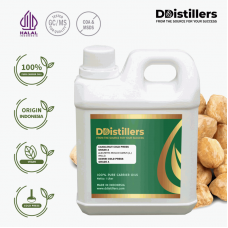
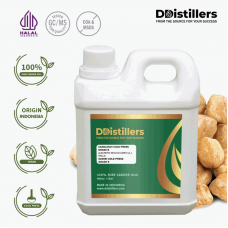
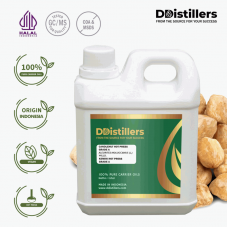
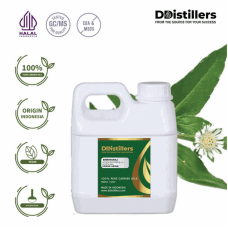
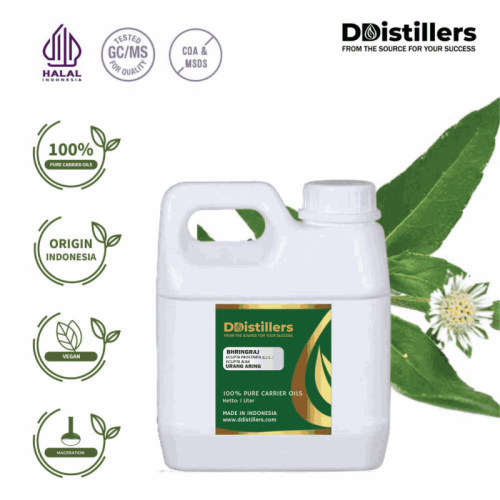
BHRINGRAJ
/ URANG ARING CARRIER OIL By DDISTILLERS
Brand:
DDistillers
Botanical name: Eclipta prostrata (L.) L. / Eclipta alba
INCI name: Eclipta alba Oil
Product category: Single carrier oil, purity: 100%
HS Code: 15159099
CAS#: 93165-22-1
FEMA#: –
Extraction method: Maceration.
PRODUCT
DESCRIPTION
Urang
Aring Oil (Eclipta prostrata (L.) L., synonym E. alba) is a
traditional herbal oil produced through maceration of fresh leaves in a carrier
oil. This method allows lipophilic bioactive compounds—such as wedelolactone,
ecliptine, prenylated flavonoids, and triterpenoids—to dissolve into the lipid
medium, yielding a therapeutic herbal oil. The maceration process is long
recommended in WHO guidelines on herbal preparation, recognized as a safe,
simple, and effective way to extract oil-soluble phytochemicals.
In
terms of specification, Urang Aring carrier oil appears as a yellowish-green to
brownish-green oily liquid, indicative of chlorophyll, carotenoids, and
phenolic pigments from the leaves. It has a characteristic herbal
aroma—reminiscent of fresh leaves with a slight earthy nuance. The texture is
smooth and emollient, providing a moisturizing sensation on skin or scalp, and
it absorbs relatively well, especially when combined with lighter carrier oils
such as almond or jojoba.
BOTANICAL
AND MORPHOLOGY
Eclipta
prostrata (syn. Eclipta alba Hassk.), belonging to the
family Asteraceae, is widely known under various names: “urang aring”
(Indonesia), “bhringraj” (India), “false daisy” (English), or “mo han lian”
(Chinese).
- Plant
type: Annual creeping herb with prostrate or slightly
erect habit, 20–60 cm tall. Stems are slender, cylindrical, green, often
covered with fine hairs, and much branched.
- Leaves:
Opposite, lanceolate to elliptic, 2–6 cm long, 1–3 cm wide, surface hairy,
margins finely serrated or nearly entire. Dark green with prominent veins.
- Flowers:
Small composite capitula, 6–8 mm in diameter, white in color. Comprising
both disc florets and ray florets. Typically borne axillary or terminally.
- Fruits:
Small, flattened achenes, ~2 mm long, black or dark brown, without pappus.
Easily dispersed by wind or water.
- Roots:
Fibrous root system, well adapted to moist soils such as rice paddies and
wetlands.
Distribution
& Habitat: Widely distributed in tropical and
subtropical regions—South Asia (India, Nepal, Sri Lanka), East Asia (China,
Japan), Southeast Asia (Indonesia, Thailand, Vietnam), Africa, Australia, and
tropical Americas. Commonly grows as a weed in moist fields, ditches, and
wetlands.
Significance:
Though often considered a weed, the plant is highly valued in traditional
medical systems such as Ayurveda, Siddha, Unani, and Traditional Chinese
Medicine (TCM).
HISTORY
AND USAGE
Urang
Aring Oil, more commonly known as Bhringraj oil in India, has a deep
historical significance in traditional Asian medicine. In Ayurveda, it has been
used for thousands of years under the name Kesharaja (“King of Hair”),
valued for its ability to strengthen hair, darken premature graying, and
promote new hair growth. Classical texts such as Bhavaprakasha and Charaka
Samhita describe its use in juice, powder, and infused oil forms (with
sesame or coconut oil) as hair tonics and liver remedies.
In
Traditional Chinese Medicine (TCM), the herb known as Mo Han Lian
is used to support liver and kidney function, stop bleeding, and preserve
natural hair color. It is cited in Bencao Gangmu (Compendium of Materia
Medica) by Li Shizhen (16th century) for liver disorders, skin infections, and
anti-aging purposes.
In
Indonesia and Southeast Asia, Urang Aring has long been a part of Jamu
tradition for hair care. The macerated oil is applied to the scalp to reduce
dandruff, strengthen hair roots, and moisturize hair. This practice has been
passed down through generations and later inspired the development of
commercial hair oils.
Modern
phytochemical and pharmacological studies confirm that E. prostrata
leaves contain coumarins (wedelolactone, demethylwedelolactone), flavonoids,
triterpenoids, and alkaloids—compounds contributing to hepatoprotective,
anti-inflammatory, and hair growth–stimulating effects. Preclinical studies
further demonstrate its ability to induce the anagen (growth) phase in hair
follicles, validating its traditional reputation as a hair tonic.
VISIT OUR MARKETPLACE:


| Specification | |
|---|---|
| Source of Material | Source Material: Eclipta prostrata (false daisy) leaves. Origin: Indonesian |
| Cultivation | Conventionally harvested and
periodically replanted to ensure sustainability |
| Main Content | Linoleic acid, palmitic acid, oleic acid, stearic acid |
| Organoleptik |
|
| Solubility | Soluble in cosmetic esters and oils; insoluble in water |
| Blend well | Blends well with essential oils and other carrier oils |
| Downstream product application | Cosmetics and Personal Care Formulation |
| Shelf Life | 2 years |
| Storage instructions | Storage Guidelines:
|
| Allergies and general precautions | Allergen &
Precautionary Notes:
|
Related Products